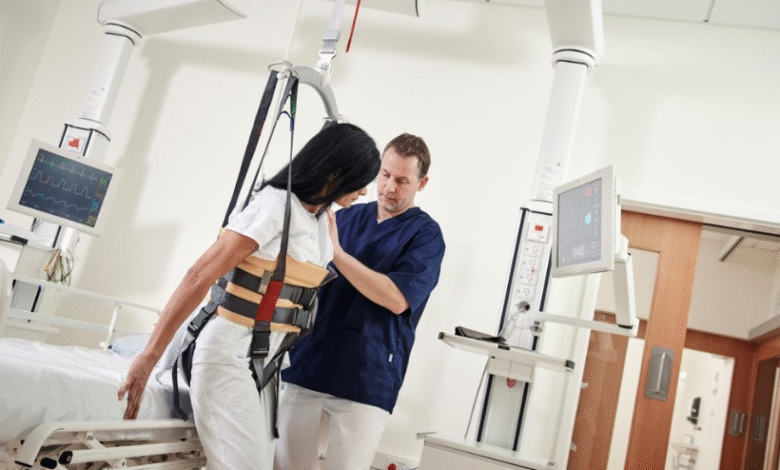
There’s a moment in many Australian care projects where someone says, “We should probably add a Ceiling Hoist.” It often comes after an injury, a complaint, a near miss, or a room that suddenly doesn’t work anymore. And while the intention is right, this is also where problems quietly begin.
Because a Ceiling Hoist is not just equipment. It’s part of the building. Part of the workflow. Part of how people move, communicate, and carry responsibility inside a space. When it’s planned well, it fades into daily life. When it’s rushed or poorly thought through, it becomes something staff work around instead of with.
Across homes, hospitals, SDA builds, and aged care facilities, the same mistakes keep recurring. Not because people don’t care, but because overhead support looks simpler than it really is.
This article examines where projects commonly go wrong and what experienced providers do differently.
Treating the Ceiling Hoist as an “Add-On” Instead of Infrastructure
One of the most common issues is timing. The Ceiling Hoist is brought in after the room is finished, after furniture is fixed, after services are run, and after the layout has emotionally settled. At that point, the hoist has to negotiate with the space rather than belong to it.
Tracks end up compromised. Transfer zones are limited. The system technically works, but never quite feels right.
Good providers push the conversation earlier. Not at handover, but at planning. They talk about how people will move through the room before discussing the equipment to be used. They consider bed positions, bathroom flow, turning circles, privacy lines, and future adaptability. When a Ceiling Hoist is designed into a space, the room feels intentional. When it’s bolted on, the room often feels managed.
And people feel that difference every day.
Designing for One Scenario Instead of Real Life
Another frequent mistake is designing a Ceiling Hoist layout around a single, idealised transfer. Bed to chair. Chair to toilet. Done.
But real care doesn’t work like that. People shift. Needs change. Furniture moves. Support levels fluctuate. Staff approaches evolve. What worked beautifully in a planning document can feel limiting within six months.
Experienced providers plan for movement, not moments. They look at whole routines. Morning care. Shower days. Night transfers. Emergency situations. Fatigue. Dignity. They design track paths that allow variation, not just completion.
A Ceiling Hoist that only supports one perfect transfer often gets bypassed for half the day. And unused support is wasted support.
See also: Small Daily Habits That Quietly Support Mental Health
Ignoring How Rooms Actually Get Used
Care rooms are rarely used the way they’re drawn. Beds drift. Chairs migrate. Storage appears. Equipment accumulates. Personal belongings grow. People claim corners. Staff develop habits.
When Ceiling Hoist systems are planned without considering real spaces, tracks can end up in the wrong places. Over beds but not over toilets. Over chairs but not over turning zones. Present, but awkward.
The better projects involve time on-site. Watching routines. Listening to carers. Asking participants what feels difficult. Not in a survey sense, but in a practical one. “Where do you hesitate?” “Where do you need help most?” “What gets in your way?”
A Ceiling Hoist designed from lived patterns tends to feel natural. One designed from drawings often feels theoretical.
Underestimating Structural Planning
Ceilings are not all equal. Neither are roof spaces, trusses, slabs, or load paths. One of the quiet failure points in Ceiling Hoist projects is structural compromise. Either over-engineering that unnecessarily drives costs, or under-planning that creates long-term risk.
Good providers involve structural thinking early. They coordinate with builders and engineers. They map loads. They futureproof. They document. They ensure that the Ceiling Hoist is not only safe on install day, but remains safe through modifications, room changes, and system extensions.
This is rarely visible once the room is finished. But it determines whether the hoist becomes trusted or quietly doubted.
And in care environments, doubt changes behaviour fast.
Focusing on Hardware Instead of Workflow
Another pattern is over-focusing on the hoist model and under-focusing on how it will be used. Speed. Controls. Charging. Storage. Handover between shifts. Emergency lowering. Sling management. Infection control. Maintenance access.
A Ceiling Hoist sits inside a working system. If that system is clumsy, the hoist becomes a source of friction rather than support.
Experienced providers spend time on training that fits the service, not just the equipment. They tailor instruction. They revisit after installation. They watch how staff actually use the hoist, not how manuals say they should.
Because a Ceiling Hoist that technically functions but disrupts workflow will always be treated as optional. And the optional safety equipment is rarely used consistently.
Designing for Today Without Respecting Tomorrow
Needs change. Participants age. Diagnoses progress. Staffing ratios shift. Services expand. Rooms get repurposed. Yet many Ceiling Hoist systems are installed as if the space will freeze in time.
This leads to short track runs. Limited coverage. Systems that cannot easily be extended. Or layouts that make future upgrades disruptive.
More forward-thinking providers treat a Ceiling Hoist like long-term infrastructure. They plan expansion paths. They leave structural options open. They consider adjacent rooms. They think about what the space might become, not just what it is now.
That mindset often saves high cost and disruption later. But more importantly, it prevents care environments from once again becoming unsuitable.
Overlooking the Emotional Layer
This is the mistake that never appears on drawings. A Ceiling Hoist changes how people feel. About safety. About dependence. About dignity. About participation.
When projects focus only on lifting function, they sometimes miss this layer. Tracks cut across personal spaces. Motors dominate sightlines. Noise becomes intrusive. Transfers feel procedural rather than supportive.
Better providers talk about experience. About where people look during a transfer. About how close staff can stand. About whether the hoist supports conversation or interrupts it. They think about lighting, privacy, and atmosphere alongside mechanics.
Because the success of a Ceiling Hoist is not only measured in kilograms. It’s measured in comfort. Confidence. And willingness to engage.
Assuming Installation Is the End
One of the quieter failures is disappearing after installation. Ceiling Hoist systems need review. Adjustments. Reconfiguration. Maintenance. Re-training. New staff onboarding. Documentation updates.
Projects that work well in the long term usually involve ongoing relationships. Providers who check back. Who tweaks layouts? Those who respond quickly when routines change. Who treat the hoist as a living part of the environment rather than a finished product.
A Ceiling Hoist that is supported after installation tends to remain central to care. One that is left alone often becomes another workaround waiting to happen.
What Good Providers Usually Do Differently
Here are a few things good providers offer:
- They start early.
- They observe before designing.
- They plan for change, not just compliance.
- They involve carers and participants.
- They coordinate structurally.
- They train for reality, not theory.
- They return after installation.
- They treat the Ceiling Hoist as part of care delivery, not just part of fitout.
And because of that, their systems tend to disappear into daily life. They stop being “the hoist.” They become “the room.”
Which is usually the goal.
Why This Matters More Now
Australian care environments are under pressure. Workforce strain. Growing complexity. More support is delivered in homes. More expectations around safety and dignity. Less tolerance for systems that only half-work.
In that context, a Ceiling Hoist from CHS Healthcare is not a small decision. It shapes routines. It influences staffing. It affects how spaces age. It touches every transfer, every day.
Getting it right rarely comes from rushing to install. It comes from slowing down early. From asking better questions. Understanding that overhead support is not a product choice, but a design responsibility.
And when that responsibility is handled well, something simple happens.
Rooms stop pushing back.
Care becomes easier to deliver.
And the Ceiling Hoist quietly does what it was meant to do.